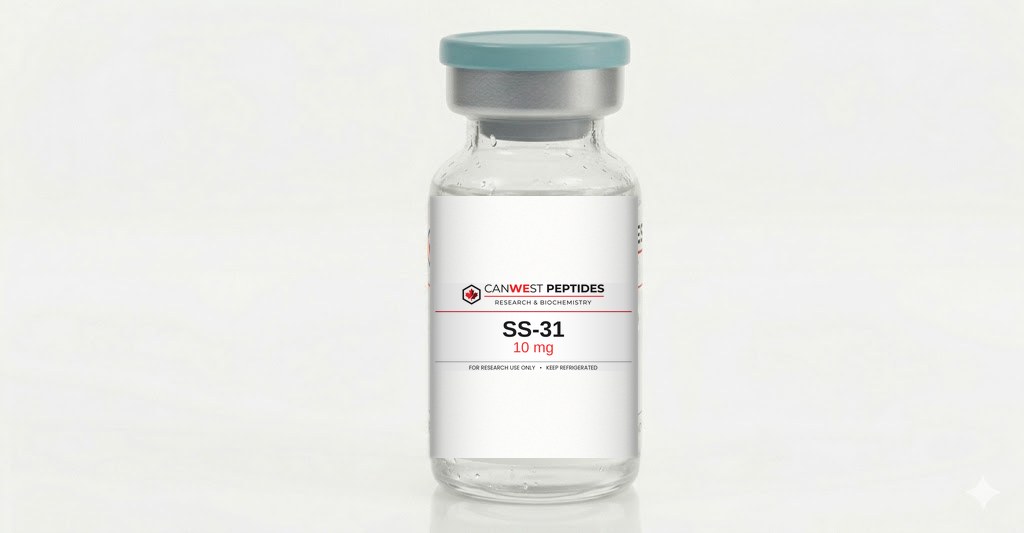
SS-31
In stock — ships from Alberta
A mitochondria-targeting tetrapeptide studied for cellular energy production, oxidative stress reduction, and mitochondrial function research.
Check Availability & Order →| Vial size | 10mg |
| Purity | ≥99% (HPLC tested) |
| Form | Lyophilized powder, sealed vial |
| Shipping | Canada-wide from Alberta · free over $300 CAD |
| Payment | Interac e-Transfer |
Compound identity
SS-31 is a synthetic, water-soluble tetrapeptide belonging to the Szeto–Schiller (SS) family of mitochondria-targeting peptides. The same molecule appears throughout the literature under several names, which is worth noting when searching databases: SS-31 is the original laboratory designation, elamipretide is the international non-proprietary name, and MTP-131 and Bendavia appear in earlier preclinical and clinical publications.
| Sequence | D-Arg–Dmt–Lys–Phe–NH₂ (Dmt = 2′,6′-dimethyltyrosine) |
| Molecular formula | C₃₂H₄₉N₉O₅ |
| Molecular weight | ≈639.8 g/mol (free base) |
| CAS number | 736992-21-5 (free base) |
| Synonyms | Elamipretide · MTP-131 · Bendavia · SS-31 |
| Peptide class | Szeto–Schiller aromatic-cationic tetrapeptide |
| Solubility | Water-soluble; supplied lyophilised |
The defining structural feature is an alternating aromatic–cationic motif. Two residues carry positive charge at physiological pH (D-arginine and lysine) and two are aromatic (dimethyltyrosine and phenylalanine), which makes the molecule amphipathic — it has both a hydrophilic and a hydrophobic face. The use of a D-amino acid at the N-terminus and a C-terminal amide are both common strategies for resisting enzymatic degradation.
Mechanism of action: cardiolipin and the inner mitochondrial membrane
SS-31's selectivity comes from its affinity for cardiolipin, an unusual four-tailed phospholipid found almost exclusively in the inner mitochondrial membrane. Cardiolipin is concentrated in the tightly curved folds of that membrane known as cristae, where the respiratory chain complexes sit. Because cardiolipin is essentially absent elsewhere in the cell, a molecule that binds it will accumulate in mitochondria without needing an active targeting system.
Published work describes SS-31 associating with cardiolipin through electrostatic interaction between its cationic residues and the anionic phospholipid head groups, while the aromatic residues insert into the lipid bilayer. Rather than being consumed in a chemical reaction, the peptide appears to act on the physical organisation of the membrane itself. Reported consequences of this interaction include:
- Cristae stabilisation. Cardiolipin is required to maintain the sharp curvature of cristae folds. SS-31 binding is described as helping preserve this architecture, which in turn preserves the surface area available for oxidative phosphorylation.
- Respiratory complex assembly. Studies report improved assembly and stability of complexes I, III and IV, and of the supercomplexes these form, with more efficient electron transfer as a result.
- Reduced electron leak. A more efficient chain leaks fewer electrons to molecular oxygen, and electron leak is a principal source of mitochondrial reactive oxygen species.
- Protection of cardiolipin from peroxidation. Oxidised cardiolipin is a trigger for cytochrome c release; limiting its peroxidation is reported to help preserve membrane potential and reduce caspase-dependent apoptotic signalling.
More recent biophysical work has argued that modulation of membrane surface electrostatics is itself a key component of the mechanism, rather than binding to any single protein target — a model consistent with the broad interaction landscape observed when SS-31 binding partners have been mapped directly.
Why it enters cells without a transporter
A peptide carrying two positive charges would not normally be expected to cross lipid membranes freely. The prevailing explanation is charge shielding: electrons in the π orbitals of the phenylalanine and dimethyltyrosine aromatic rings partially mask the positive charges of the arginine and lysine residues, lowering the energetic penalty of membrane passage. Uptake is therefore described as largely independent of membrane potential and of any dedicated transporter — a point of practical significance in experimental models where mitochondria are already depolarised, since potential-dependent mitochondrial probes accumulate poorly under exactly those conditions.
Origin and research history
The SS peptide series originated in collaborative work between Hazel Szeto at Weill Cornell Medical College and Peter Schiller at the Institut de recherches cliniques de Montréal (IRCM) — making SS-31 a compound with a partly Canadian discovery lineage. The series was originally investigated for unrelated reasons before the mitochondrial targeting behaviour was recognised.
The compound was subsequently developed by Stealth BioTherapeutics and carried into clinical study across a wide range of conditions with a mitochondrial component, including heart failure, ischemia-reperfusion injury, primary mitochondrial myopathy, dry age-related macular degeneration and Barth syndrome. That programme produced a mixed record: several larger trials did not meet their primary endpoints, which is itself informative context for anyone reading the preclinical literature.
In September 2025 elamipretide received FDA accelerated approval under the brand name Forzinity for Barth syndrome in patients weighing at least 30 kg — the first therapy approved to act directly on mitochondria. Approval was based on improvement in knee extensor muscle strength as a surrogate endpoint, with a confirmatory randomised placebo-controlled trial required post-approval. Reported adverse events were predominantly mild-to-moderate injection-site reactions.
Regulatory note: the approval described above applies to a specific pharmaceutical product, manufactured and prescribed under that approval, for a single rare indication. It is recorded here as scientific and regulatory background only. Material supplied by CanWest Peptides is research-grade compound for in vitro laboratory use and is not a medicine, not an approved product, and not for human consumption.
Areas of published research
Literature involving SS-31 concentrates on experimental models where mitochondrial dysfunction is the variable of interest. Recurring areas include:
- Cardiac models — ischemia-reperfusion injury, heart failure with reduced ejection fraction, and mitochondrial morphology in Barth syndrome models
- Skeletal muscle bioenergetics and exercise-capacity models
- Renal models, particularly ischemic and diabetic kidney injury
- Neurological and neurodegenerative models involving oxidative stress
- Ageing biology, including cristae morphology and respiratory capacity in aged tissue
- Ophthalmic models relating to retinal pigment epithelium mitochondrial function
Laboratory handling, storage and reconstitution
The following reflects general handling practice for lyophilised research peptides and is provided for laboratory use.
Storage
- Lyophilised powder: keep sealed and protected from light. −20 °C is standard for long-term storage; short periods at 2–8 °C are generally acceptable during transit and handling.
- After reconstitution: refrigerate at 2–8 °C, protected from light, and use within the working window appropriate to the protocol. Avoid repeated freeze–thaw cycles, which are a common and avoidable source of degradation.
- Allow sealed vials to reach room temperature before opening to limit condensation onto the powder.
Reconstitution
Lyophilised peptide is typically reconstituted with bacteriostatic or sterile water introduced slowly down the inner wall of the vial rather than directly onto the powder cake. The vial is then swirled gently until dissolved — not shaken, as mechanical agitation and foaming can denature peptides. A 10 mg vial reconstituted with 2 mL of solvent yields a working concentration of 5 mg/mL; the site's reconstitution calculator will work out other volume-to-concentration combinations.
Purity and analysis
Material supplied by CanWest Peptides is specified at ≥99% purity by HPLC and supplied as a lyophilised powder in a sealed vial. Purity matters more than usual for a compound of this type: because SS-31's behaviour depends on a precise arrangement of charged and aromatic residues, truncated or modified synthesis by-products are not simply inert filler — they can carry different membrane behaviour. Identity and purity documentation is available on request.
Common questions
Is SS-31 the same thing as elamipretide?
Yes — the same tetrapeptide. SS-31 is the laboratory designation from the Szeto–Schiller series and elamipretide is the international non-proprietary name. Searching both terms, plus MTP-131 and Bendavia, will surface materially more literature than any one of them alone.
How does SS-31 differ from other mitochondrial compounds?
Most mitochondria-directed molecules are either antioxidants that scavenge reactive species after they form, or lipophilic cations that accumulate in response to membrane potential. SS-31 is described as working differently: it binds a structural lipid and acts on membrane organisation, with reduced ROS reported as a downstream consequence of improved electron-transfer efficiency rather than as direct scavenging. MOTS-c, by contrast, is a mitochondrial-derived peptide studied as a signalling molecule rather than a membrane-structural one.
Is SS-31 available from a Canadian supplier?
Yes. CanWest Peptides is based in Alberta and ships Canada-wide, which avoids cross-border transit times and customs handling for Canadian research buyers. All material is supplied for in vitro laboratory research use only.
Ordering SS-31 in Canada
CanWest Peptides is an Alberta-based Canadian supplier of research-grade compounds. Orders are placed through our main catalogue, paid by Interac e-Transfer, and processed within 48 hours. Orders over $300 CAD ship free anywhere in Canada; smaller orders ship at a flat $25 CAD rate. Every compound is third-party purity verified at ≥99%.
References
- Mitchell W. et al. The mitochondria-targeted peptide SS-31 binds lipid bilayers and modulates surface electrostatics as a key component of its mechanism of action. Journal of Biological Chemistry, 2020.
- Chavez J.D. et al. Mitochondrial protein interaction landscape of SS-31. Proceedings of the National Academy of Sciences, 2020.
- Elamipretide: A Review of Its Structure, Mechanism of Action, and Therapeutic Potential. International Journal of Molecular Sciences, 2025.
- Contemporary insights into elamipretide's mitochondrial mechanism of action and therapeutic effects. Pharmacological Research, 2025.
- U.S. Food and Drug Administration. FDA Grants Accelerated Approval to First Treatment for Barth Syndrome. 19 September 2025.
References are provided so readers can locate primary sources. Their inclusion describes the published research record and does not constitute a claim about any product supplied by CanWest Peptides.